



| Original Research | ||
Natl. J. Physiol. Pharm. Pharmacol. (2026), Vol. 16(1): 36-40 Original Research Correlation between hand grip dynamometer and mossos’ ergography in physically active and inactive individuals: A cross-sectional studyKarthika U. T.1* and K. R. Reshmy21Sarada Krishna Homeopathic Medical College, Affiliated to The Tamil Nadu Dr. M.G.R. Medical University, Chennai, India 2Department of Human Physiology and Biochemistry, Sarada Krishna Homeopathic Medical College, Affiliated to The Tamil Nadu Dr. M.G.R. Medical University, Chennai, India *Corresponding Author: Sarada Krishna Homeopathic Medical College, Affiliated to The Tamil Nadu Dr. M.G.R. Medical University, Chennai, India. Email: karthichithra854 [at] gmail.com Submitted: 26/08/2025 Revised: 02/02/2026 Accepted: 22/02/2026 Published: 12/03/2026 © 2025 National Journal of Physiology, Pharmacy and Pharmacology
ABSTRACTBackground: Handgrip strength is a quick and reliable indicator of general muscle strength and functional capacity. Its relationship with muscle endurance, as assessed by Mosso’s Ergograph, has not been widely explored in young adults. Aim: This study aimed to compare handgrip strength and muscle endurance in physically active and inactive young adult females and analyze the correlation between grip strength and endurance parameters. Methods: Thirty female participants aged 22 to 26 years were categorized as physically active or inactive using the IPAQ. The handgrip strength was measured using a standard dynamometer. Muscle endurance was assessed using Mosso’s Ergograph by recording work done (kg·m), time to fatigue, and the total number of contractions. Independent sample t-tests were used to compare the groups. Pearson’s correlation analysis was used to examine the association between handgrip strength and endurance measures. Results: The physically active group demonstrated significantly higher mean handgrip strength (Active vs. Inactive, p = 0.0048) and greater work done (kg·m) (Active vs. Inactive, p = 0.0304). There was a moderate positive correlation between grip strength and work done (kg·m) (r = 0.57, p = 0.012) and between grip strength and the number of contractions (r = 0.55, p = 0.014). Conclusion: Handgrip strength shows a moderate positive correlation with muscle endurance as measured by Mosso’s Ergograph. This supports the use of handgrip dynamometry as a simple, indirect proxy for assessing general muscle endurance, with implications for musculoskeletal health, physiology education, rehabilitation protocols, and fatigue-related research. Keywords: Handgrip dynamometer, Mosso’s Ergograph, Muscle endurance, Physical activity, Correlation, IPAQ. IntroductionMuscle endurance is the capacity of a muscle or muscle group to maintain repeated contractions or a static contraction for a prolonged period without experiencing tiredness. In contrast to muscular strength, which measures the maximum force in a single effort, muscular endurance indicates how long muscles can do a task before becoming fatigued (Enoka and Duchateau, 2007 ). Cardiovascular fitness, oxygen transport, mitochondrial efficiency, and the usage of slow-twitch muscle fibers are some of the variables that affect it. Muscle endurance is developed through exercises including swimming, cycling, long-distance running, and high-repetition resistance training. Increasing muscle endurance improves posture, everyday functioning, sports performance, and injury avoidance (Karst et al., 1986). Muscle fatigue refers to the decline in muscle performance due to repeated and intense use. Fatigue is a reversible physiological state in which there is an objective reduction in performance, or its absence, resulting from continuous or prolonged activity. (Mohan et al., 2016). Musculoskeletal (MSK) conditions affect approximately 1.71 billion people globally and are the leading cause of disability worldwide. Low back pain alone affects 570 million people and is the leading cause of disability in 160 countries. Other major MSK conditions include osteoarthritis, fractures, neck pain, amputations, gout, and rheumatoid arthritis. Together, these conditions account for 17% of global years of disability, affecting people of all ages, especially during their most productive years, with the highest burden seen in high-income regions and parts of the Western Pacific and Southeast Asia (WHO, 2022). The ergograph was developed in the early 1880s by Italian scientist Angelo Mosso to assess human muscular endurance and fatigue objectively. As the individual lifts a weight, the device isolates small muscle groups, usually the finger flexors, and records repetitive contractions, creating an ergogram that illustrates the progression of fatigue (Nicolas et al., 2017). Mosso’s research also established the foundation for experimental psychology by connecting mental attributes like willpower with physical endurance. His influential piece La Fatica (1891) (Di Giulio et al., 2006) examined the relationship between the environment, daily routines, training, and fatigue. Modern ergographs are still a useful instrument for researching the function of the hand and forearm muscles and the variables affecting fatigue and work capacity. (Di Guilio et al., 2006 ; Srivatsav et al., 2024). Muscle endurance is a critical component of physical fitness, and it varies significantly between individuals who are physically active and those who are inactive due to differences in activity levels and lifestyle habits. Despite its importance, limited research has quantified these differences in young adults using objective tools such as Mosso’s Ergography. This study aims to address this gap by assessing and comparing the muscle endurance of physically active and inactive young adults, providing insights into the influence of regular physical activity on muscle fatigue resistance and recovery. Aims and ObjectivesTo evaluate and compare the muscle endurance and strength of physically active and inactive young adults using Mosso’s ergography and handgrip dynamometer. MethodologyEthical approvalThe Institutional Ethics Committee of Sarada Krishna Homeopathic Medical College reviewed and approved the study protocol (Approval No: SKHMC/IEC/534/2025). All procedures were conducted in accordance with ethical standards. Study settingThis cross-sectional study was conducted in the Department of Physiology, Sarada Krishna Homeopathic Medical College, Tamil Nadu, India. ParticipantsThirty female (n=30) participants aged 22 to 26 years were recruited and categorized as physically active (n = 15) or inactive (n = 15) based on their International Physical Activity Questionnaire (IPAQ) scores. Inclusion criteria
Exclusion criteria
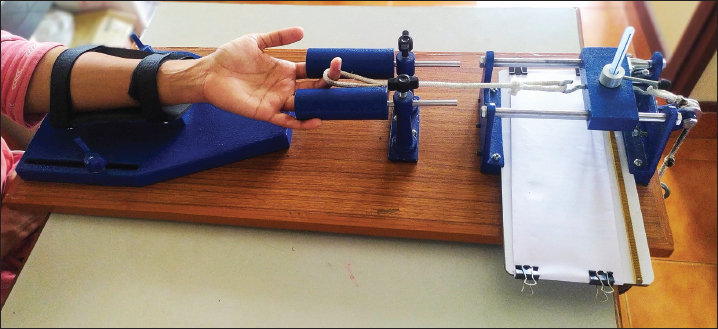
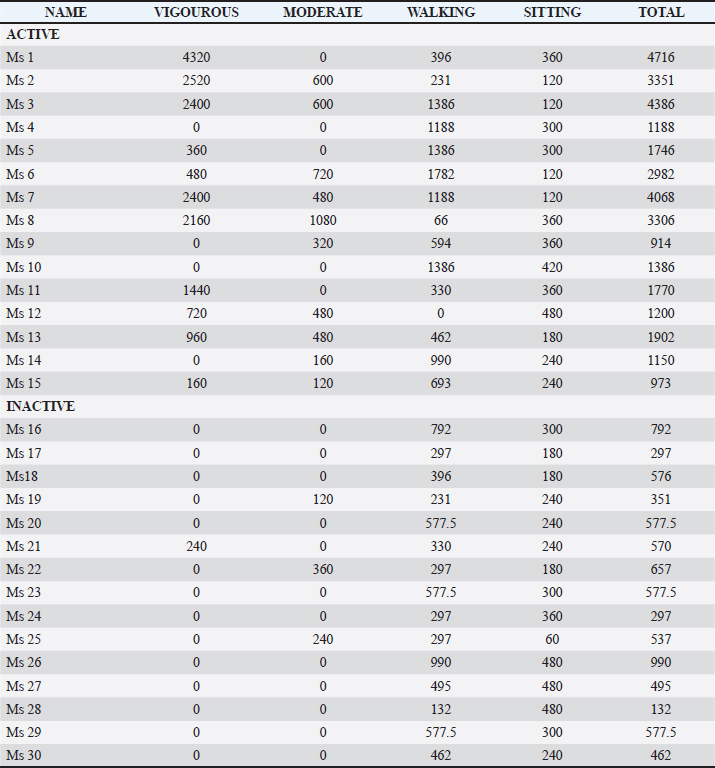
ProcedureParticipants were grouped according to their IPAQ scores (Table 1) and provided consent. Handgrip strength was measured using a standard handgrip dynamometer. Each participant squeezed maximally in three trials, and the average was recorded. Muscle endurance was then tested using Mosso’s Ergograph (Fig. 1): participants lifted a 2.5 kg load with the middle finger of the non-dominant hand every 2 s until fatigue, and their work done was calculated. The distance covered in meters (D) is measured using a measuring scale to calculate the work done. Force (F) is the load in Kg against which the muscle contracts. Work done (kg·m) is then calculated using the following formula: Work (kg m)=Force (kg) × Distance (m) and statistically verified by an independent t-test and Pearson’s correlation.
Fig. 1. Mossos’ ergography. Table 1. Distribution of participants according to IPAQ scores.
ResultsA total of 30 young adult female (n=30) participants were included and divided equally into physically active (n = 15) and inactive (n = 15) groups based on the IPAQ scoring. Table 2 presents the mean values for hand grip strength, Mosso’s Ergograph work done (kg·m), and number of contractions for both groups. (Table 2) Participants in the physically active group demonstrated significantly higher mean hand grip strength than those in the inactive group. Similarly, the work done (kg·m) and number of contractions measured by Mosso’s Ergograph were significantly greater in the active group than in the passive group (Table 3). Table 2. Statistics.
Table 3. Interpretation.
Pearson’s correlation analysis showed a moderate positive correlation between handgrip strength and work done (kg·m) on Mosso’s Ergograph (r = 0.57, p = 0.012) and between grip strength and number of contractions (r = 0.55, p = 0.014). This suggests that higher grip strength is associated with better muscle endurance. DiscussionThis study compared hand grip strength and muscle endurance between physically active and inactive young adult females and explored their correlation. Physically active participants had significantly higher hand grip strength, greater work done (kg·m), and more contractions on Mosso’s Ergograph than their inactive peers. These results are consistent with existing evidence that regular physical activity improves both the maximum isometric strength and endurance capacity of skeletal muscles (Mohan et al., 2016). Handgrip strength is widely recognized as a simple, quick, and reliable proxy for overall muscle strength and has been associated with functional ability, nutritional status, and general health outcomes in various populations. Although a classical tool, Mosso’s Ergograph remains valuable in demonstrating localized muscle endurance and fatigue mechanisms under standardized laboratory conditions. The combination of both measures provides a practical way to understand the relationship between peak muscle strength and sustained work performance in the same muscle group (Bohannon, 2008). The moderate positive correlation between handgrip strength and work done (kg·m) (r = 0.57, p = 0.012) and between grip strength and number of contractions (r = 0.55, p = 0.014) suggests that individuals with greater maximum strength also tend to exhibit higher endurance (Nemoto et al., 2024). This relationship can be explained by enhanced neuromuscular efficiency, greater recruitment of fatigue-resistant muscle fibers, and superior local oxygen delivery in physically active individuals. These findings reinforce the practical value of handgrip dynamometry as an indirect indicator of general muscle endurance, particularly in contexts where direct endurance testing is not feasible. This approach can be especially useful in field-based assessments, community health screenings, and educational settings where students are introduced to muscle physiology fundamental concepts. LimitationsThe sample size in this study was relatively small and restricted to a single institution, which may limit the generalizability of the findings. Future research should involve larger, multicenter cohorts to further validate the observed strength–endurance correlation across different age groups, sexes, and populations. Incorporating biochemical markers such as cortisol and electrophysiological measures such as electromyography could enhance the accuracy and mechanistic understanding of muscle endurance and fatigue in subsequent investigations. ConclusionThis study demonstrates that physically active young adult females exhibit significantly higher handgrip strength and greater muscle endurance than their inactive peers. The moderate positive correlation between handgrip strength and endurance measures recorded by Mosso’s Ergograph (r=0.57, p=0.012; r=0.55, p=0.014) (Table 2) suggests that maximum isometric strength is closely linked with sustained muscle performance within the same muscle group. These findings emphasize the practical value of combining handgrip dynamometry with Mosso’s Ergograph for assessing and demonstrating muscle strength and endurance in both physiology education and community or basic health screening contexts. AcknowledgmentWe sincerely express our gratitude to all those who contributed to the successful completion of this study. We extend our heartfelt gratitude to the management of the collegiate research laboratory, Kulasekharam, for providing the necessary facilities and support throughout the study. We also thank all individuals who directly or indirectly contributed to this research. FundingNo funding is available. Conflict of InterestNone. Authors ContributionDr Karthika U. T. – Conceptualization of the study, data collection, statistical analysis, interpretation of results, and manuscript drafting. Dr. K. R. Reshmy – Study design guidance, critical manuscript revision, and overall supervision. ReferencesBohannon, R.W. 2008. Hand-Grip Dynamometry Predicts Future Outcomes in Aging Adults. J. Geriatric. Phys. Therapy. 31(1), 3–10; doi:10.1519/00139143-200831010-00002 Di Giulio, G., Fumagalli, D.D.D.D. and Tipton, C.M. 2006. Angelo Mosso and Muscle Fatigue: 116 Years after the First Congress of Physiologists: IUPS Commemoration. Adv. Physiol. Educ. 30(2), 51–57. Enoka, R.M. and Duchateau, J. 2008. Muscle Fatigue: what, Why, and How It Influences Muscle Function. J. Physiol. 586(1), 11–C23; doi:10.1113/jphysiol.2007.139477 Karst, H. W. D., McArdle, F. I., Katch, und V. L. Katch: Exercise Physiology—Energy, Nutrition, and Human Performance. 2nd ed. Lea & Febiger;1986.Food/Nahrung.1987;31(5-6):)396. doi:10.1002/food.19870310513 Mantur, V.S., Hiremath, S.S. and An, K. 2022. Impact of examination stress on musculoskeletal strength and fatigue in first-year medical students using Mosso’s ergograph. Medica. Innovatica. 11(2). Mohan, S., Geetha, G.B. and R P. 2016. Muscle function in young adults. Sch. J. Appl. Med. Sci. 4(7), 2348–2352. Nemoto, S., Nakabo, T., Tashiro, N., Kishino, A., Yoshikawa, A., Nakamura, D. and Geshi, E. 2024. Relationship among Muscle Strength, Muscle Endurance, and Skeletal Muscle Oxygenation Dynamics during Ramp Incremental Cycle Exercise. Sci. Rep. 14(1), 11676; doi:10.1038/s41598-024-61529-x Nicolas, S. and Vobořil, D. 2017. Ergographs and dynamographs: new devices at the turn of the century for measuring muscular fatigue and endurance. L’Année. Psychol. 117(3), 311–349. Srivatsav, B., Srinivas, S., Sure, S.S., Suganya, K., Nirangjhana, S. and Divyalakshmi, K. 2024. A comparative study to assess the work done by medical students with and without a workout routine using Mosso’s ergograph. Bioinformation 20(12), 2086–2090. WHO. 2022. Musculoskeletal health. WHO. Available via https://www.who.int/news-room/fact-sheets/detail/musculoskeletal-conditions | ||


| How to Cite this Article |
| Pubmed Style R DRK, , Reshmy KR. Correlation between hand grip dynamometer and mossos’ ergography in physically active and inactive individuals: A cross-sectional study. Natl J Physiol Pharm Pharmacol. 2026; 16(1): 36-40. doi:10.5455/NJPPP.2026.v16.i1.6 Web Style R DRK, , Reshmy KR. Correlation between hand grip dynamometer and mossos’ ergography in physically active and inactive individuals: A cross-sectional study. https://www.njppp.com/?mno=279871 [Access: June 26, 2026]. doi:10.5455/NJPPP.2026.v16.i1.6 AMA (American Medical Association) Style R DRK, , Reshmy KR. Correlation between hand grip dynamometer and mossos’ ergography in physically active and inactive individuals: A cross-sectional study. Natl J Physiol Pharm Pharmacol. 2026; 16(1): 36-40. doi:10.5455/NJPPP.2026.v16.i1.6 Vancouver/ICMJE Style R DRK, , Reshmy KR. Correlation between hand grip dynamometer and mossos’ ergography in physically active and inactive individuals: A cross-sectional study. Natl J Physiol Pharm Pharmacol. (2026), [cited June 26, 2026]; 16(1): 36-40. doi:10.5455/NJPPP.2026.v16.i1.6 Harvard Style R, D. R. K., & Reshmy, . K. R. (2026) Correlation between hand grip dynamometer and mossos’ ergography in physically active and inactive individuals: A cross-sectional study. Natl J Physiol Pharm Pharmacol, 16 (1), 36-40. doi:10.5455/NJPPP.2026.v16.i1.6 Turabian Style R, Dr Reshmy K, Karthika U T Karthika U. T., and K. R. Reshmy. 2026. Correlation between hand grip dynamometer and mossos’ ergography in physically active and inactive individuals: A cross-sectional study. National Journal of Physiology, Pharmacy and Pharmacology, 16 (1), 36-40. doi:10.5455/NJPPP.2026.v16.i1.6 Chicago Style R, Dr Reshmy K, Karthika U T Karthika U. T., and K. R. Reshmy. "Correlation between hand grip dynamometer and mossos’ ergography in physically active and inactive individuals: A cross-sectional study." National Journal of Physiology, Pharmacy and Pharmacology 16 (2026), 36-40. doi:10.5455/NJPPP.2026.v16.i1.6 MLA (The Modern Language Association) Style R, Dr Reshmy K, Karthika U T Karthika U. T., and K. R. Reshmy. "Correlation between hand grip dynamometer and mossos’ ergography in physically active and inactive individuals: A cross-sectional study." National Journal of Physiology, Pharmacy and Pharmacology 16.1 (2026), 36-40. Print. doi:10.5455/NJPPP.2026.v16.i1.6 APA (American Psychological Association) Style R, D. R. K., & Reshmy, . K. R. (2026) Correlation between hand grip dynamometer and mossos’ ergography in physically active and inactive individuals: A cross-sectional study. National Journal of Physiology, Pharmacy and Pharmacology, 16 (1), 36-40. doi:10.5455/NJPPP.2026.v16.i1.6 |