



| Original Research | ||
Natl. J. Physiol. Pharm. Pharmacol. (2026), Vol. 16(1): 30-35 Research Article Quantitative determination and chromatographic analysis of essential oil from Valerian officinalis leavesFisiuk Alexandr*, Mushkina Olga, Yorshyk Olga, Valochnik Maryia and Sheuchuk SviatlanaDepartment of Organization of Pharmacy with Advanced Training Course and Retraining, Educational Institution “Belarusian State Medical University”, Minsk, Belarus *Corresponding Author: Fisiuk Alexandr. Department of Organization of Pharmacy with Advanced Training Course and Retraining, Educational Institution “Belarusian State Medical University”, Minsk, Belarus. Email: a.fisiuk [at] yandex.by Submitted: 20/08/2025 Revised: 02/12/2025 Accepted: 28/12/2025 Published: 03/03/2026 © 2025 National Journal of Physiology, Pharmacy and Pharmacology
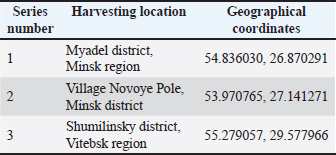
ABSTRACTBackground: Essential oils have a wide range of pharmacological activities, which determine their widespread use in medicine. Rhizomes with roots Valerian officinalis are used in medicine as sedatives and hypnotics. The pharmacological effect of this type of raw material is due, among other things, to essential oils. The leaves of V. officinalis, according to the literature, have a composition similar to that of rhizomes with roots and are promising for study in order to expand the range of raw medicinal plant materials for domestic production. Aim: The aim of this study was to quantify the essential oil content in the leaves of V. officinalis and qualitatively analyze it using thin-layer chromatography. Methods: Three series of V. officinalis leaves were harvested in 2023 from different regions of Belarus. The quantitative determination of essential oil was carried out in accordance with the State Pharmacopoeia of the Republic of Belarus by steam distillation using a Ginsberg apparatus (method B), Clevenger apparatus (method A), and Clevenger apparatus (method C). Qualitative analysis of the essential oil obtained from the leaves of V. officinalis was performed using thin-layer chromatography. Results: Obtaining essential oil using methods B and C does not allow the extraction of essential oil for further analyses. The essential oil obtained using the Clevenger device (method A) has a light yellow color, does not thicken, does not form an emulsion, and has a peculiar pungent odor characteristic of the producing plant. Conclusion: The experimentally selected optimal conditions used to quantitatively determine the essential oil of V. officinalis leaves (method A, in accordance with the State Pharmacopoeia of the Republic of Belarus), when distilled for 4 hours, with a raw material-water ratio of 1:10 and using xylene essential oil as a solvent. The quantitative content of essential oil in the leaves of V. officinalis was 9.20 ± 0.67 ml/kg. The essential oil of V. officinalis leaves is composed of sesquiterpene acids, specifically valerenic acid and acetoxyvalerenic acid. Keywords: Essential oil, Valerian officinalis, Ginsberg apparatus, Clevenger apparatus. IntroductionEssential oils are complex mixtures of aromatic substances belonging to various classes of organic compounds, mainly terpenoids, and less often aromatic and aliphatic compounds. Essential oils have a wide range of pharmacological activities (anti-inflammatory, antibacterial, analgesic, antispasmodic, local irritant, sedative, and so on). Both pure essential oils and medicinal plants are widely used in medicine (Ponomareva et al., 2015). A number of medicinal plants included in the State Pharmacopoeia of the Republic of Belarus are standardized according to the essential oil content. Valerian officinalis is one of the most popular plants containing essential oils and is used as a sedative. Based on the underground organs of V. officinalis, 5 dosage forms (tablets, capsules, dragees, tincture, and crushed medicinal plant materials) are registered on the market in Belarus. Of particular interest from the perspective of resource reserves, rational use and processing of medicinal plant raw materials are the aerial parts of V. officinalis. The leaves of V. officinalis have a similar composition to that of rhizomes with roots and are promising for study to expand the range of medicinal plant raw materials for domestic production (Shkrobotko, 2009; Kolosova, 2023). More than 100 compounds have been identified in the rhizomes with the roots of V. officinalis, including 69 essential oil components, at least 15 organic acids, 10 alkaloids, and other substances. The main classes of substances in the chemical composition of rhizomes with roots of V. officinalis are iridoids and essential oils (in particular bicyclic monoterpenes) (Tarasenko et al., 2008). Bicyclic monoterpenes (camphene, a-pinene, and d-terpineol); sesquiterpenes; formic, acetic, butyric, and valeric esters of borneol; kessilol alcohol (proazulene), valepotriates (up to 5% - valtrate, dihydrovaltrate), tannins, saponins, hydroxycinnamic acids [3,5- and 4,5- dicoffeilquinic acid, isoferulic (6%), isochlorogenic (7%), caffeic (15%), neochlorogenic (5%), p-coumaric (4%), synapic (8%), ferulic (25%), and chlorogenic (30%) acids] were define (Dadaev et al., 2021). Glycosides (valeride, valerosides A, B, and C), monoterpene alcohol mertinol in free form, and its ethers with isovaleric acid ester were detected. Aglycone valerosides A, B, and C are valerogenin, nitrogen-containing alcohol C6H13ON, and kessil alcohol C15H26O2 (proazulene) (Dadaev et al., 2021). Rhizomes with roots contain macroelements (mg/g): K 7.80, Ca 2.10, Mn 1.80, Fe 0.50; microelements: Mg 0.20, Cu 0.12, Zn 0.36, Cr 0.13, Al 0.41, Ba 0.27, V 0.19, Se 2.89, Ni 0.66, Sr 0.06, Pb 0.02, I 0.12, and B 8.80 µg/g (Dadaev et al., 2021). Iridoids have also been identified, including voltaltrates A and B, sesquiterpenoids - E-(-)-3β,4β- epoxyvalerenal , E-(-)-3β,4β- epoxyvalerenyl acetate, and mononorvalerenone (Wang et al., 2009). Valepotriates are the epoxides of bicyclic monoterpenes iridoids. These iridoids have a cyclopentanepyran skeleton with five hydroxyl groups. Two of these hydroxyls form an epoxide, while the remaining three are esterified with aliphatic acids. During the drying process of freshly dug roots, valepotriates undergo partial enzymatic hydrolysis, resulting in the formation of free isovaleric acid and its derivatives, as well as the iridoid baldrinal. In this case, the raw material develops a distinct valerian odor (Stanishevskay et al., 2015). Of the alkaloids and other nitrogen-containing compounds in valerian raw materials, actinidin, valerianine, valerin, chatinin, naphthyridyl-2,7-methylketone, choline, pyryl-alpha-methylketone, and others have been identified (Stanishevskay et al., 2015). In addition, enzymes were found (catalase, oxidase, peroxidase, lipase, and linamerase); polysaccharides consisting of galactose, glucose, arabinose, xylose, and galacturic acid; carotenoids, among which beta-carotene predominates; tocopherols, as well as a number of organic (formic, acetic, malic, and numerous derivatives of valeric acid) acids (Stanishevskay et al., 2015). The amino acid composition of V. officinalis raw materials is diverse, including 11 monoaminomonocarboxylic acids (Ala, Val, Gly, Ile, Leu, Met, Ser, Thr, Tyr, Phe, and Cys), 2 monoaminodicarbonic acids (Asp, Glu), 3 diaminodicarbonic acids (Arg, Lys, OH-Lys), and 3 heterocyclic acids (Hys, Pro, OH-Pro) (Fursa et al., 2016). All methods for the quantitative determination of essential oils (methods A-E using the Ginsberg and Clevenger apparatus, in accordance with the State Pharmacopoeia of the Republic of Belarus) are based on the steam distillation of essential oils from plant materials. The essential oil is collected by a graduated receiver. Depending on the composition of the essential oil components, the graduated receiver is filled with water, xylene, or decalin. A necessary step in the development of methods for the quantitative determination of essential oils is the selection of optimal conditions for steam distillation: the ratio “raw material-water”, and the determination of the nature of the solvent for filling the graduated receiver. The present study aimed to perform a quantitative determination of the essential oil in the leaves of V. officinalis and to determine the qualitative composition of the essential oil of the leaves using thin-layer chromatography. Materials and MethodsTo obtain essential oil, three series of medicinal V. officinalis leaves were collected at the end of August 2023 in different regions of Belarus after being dried using air shade drying (Table 1). The quantitative determination of essential oil was performed in triplicate for each series of leaves of V. officinalis. To develop a method for the quantitative determination of essential oils, it is necessary to select: a method for the quantitative determination of essential oils, a raw material-water ratio, and a solvent for filling the calibration cylinder. The quantitative determination of essential oil was carried out in accordance with the State Pharmacopoeia of the Republic of Belarus by steam distillation using the Ginsberg apparatus (method B), Clevenger apparatus (method A), and Clevenger apparatus (method C) (Figs. 1–3) (Sheryakov, 2012). Quantitative determination of the essential oil content of V. officinalis leaves using the Ginsberg apparatus (method B)Different weights of crushed leaves of V. officinalis were placed in a 1,000 ml round-bottom flask, and different amounts of purified water were added (Table 2). The amounts of crushed leaves and purified water used to obtain the essential oil of V. officinalis leaves are presented in Table 2. Distillation was performed within 4 hours after boiling. After cooling to room temperature (25°С), the volume of the essential oil obtained from the V. officinalis leaf was measured. Table 1. Characteristics of series of leaves of V. officinalis.
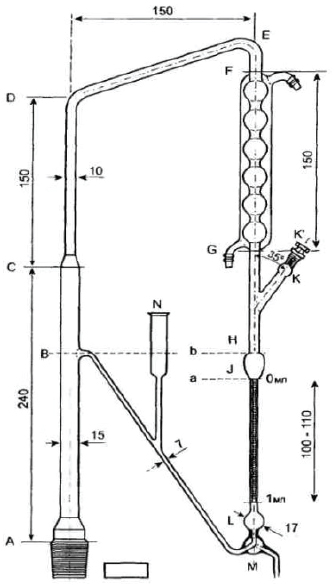
Fig. 1. Condensing system of a Clevenger apparatus for quantitative determination of essential oil (method A). Quantitative determination of the essential oil content of V. officinalis leaves using the Clevenger apparatus (method C)In a 1,000 ml round-bottomed flask, 50.0 g of crushed V. officinalis leaves were combined with 500 ml of purified water using an experimental raw material-water ratio of 1:10. The flask was connected to a steam-conducting curved tube, and distillation was performed within 4 hours of boiling, as indicated by the calibration tube filled with water. After cooling to room temperature (25°С) and draining the distillate using the graduated part of the device, the volume of the essential oil obtained from V. officinalis leaves was measured. Table 3 presents the quantitative content of essential oil in the leaves of V. officinalis.
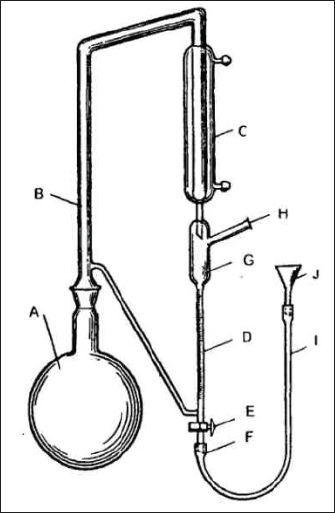
Fig. 2. Ginsberg apparatus for the quantitative determination of essential oil (method B). А – round-bottomed flask, В – stopper, С – reverse ball cooler, D – graduated receiver. Quantitative determination of the essential oil content of V. officinalis leaves using the Clevenger apparatus (method A)In a 1,000 ml round-bottomed flask, 50.0 g of crushed V. officinalis leaves were combined with 500 ml of purified water using an experimental raw material–water ratio of 1:10. The distillation process involved connecting a flask to a steam-conducting curved tube and filling the calibration tube with water. Next, 0.5 ml of xylene was added to the expanded part of the receiver. Distillation was carried out within 4 hours of boiling. After cooling to room temperature (25°С) and draining the distillate, the volume of the essential oil obtained from V. officinalis leaves was measured using the graduated part of the device. The essential oil content in the leaves of V. officinalis was determined in ml/kg. Qualitative analysis of the essential oil obtained from the leaves of V. officinalis was performed using thin-layer chromatography on Sorbfil PTSH-AF-A-UF plates. The mobile phase composition was experimentally determined. Mobile phase system for the separation of essential oil from V. officinalis leaves: ethyl acetate-hexane (1:9). Mobile phase front: 15 cm from the starting line of the chromatographic plate. The essential oil of V. officinalis leaves was prediluted with 96% ethyl alcohol at a ratio of 1:10. Reference standards: acetoxyvalerenic acid, valerenic acid. Sample volume applied: 20 µl in 10-mm strips. The qualitative analysis of the essential oil of V. officinalis leaves using thin-layer chromatography was performed using two detection options:
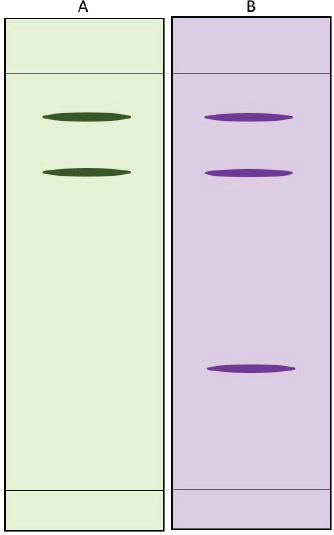
Fig. 3. A Clevenger apparatus for quantitative determination of essential oil (method C). A – round-bottomed flask; B – steam pipe; C – refrigerator; D – graduated receiver tube; E – crane; F – drain tube; G, H – expansion with solvent injection tube, I – rubber tube for filling the receiver, J – funnel. A. Observed under ultraviolet light at a wavelength of 254 nm. B. The chromatographic plate was developed by spraying with an anisaldehyde solution and heating at a temperature of 105°C–110°C. Observed in daylight. ResultsQuantitative determination of the essential oil content of V. officinalis leaves using the Ginsberg apparatus (method B)When the ratio of V. officinalis leaves to water was 3:8, the receiver was only filled with water, indicating an insufficient amount of purified water in relation to the amount of raw material taken during the distillation of the essential oil of the leaves. When distilling the essential oil of V. officinalis leaves at a ratio of V. officinalis leaves to water of 1:16, an accumulation of a pasty mass of light green color with a strong, unpleasant, acidic odor, which is not characteristic of the production plant, was observed in a graduated receiver. Quantitative determination of the essential oil content of V. officinalis leaves using the Clevenger apparatus (method C)During the distillation of V. officinalis leaves using the Clevenger apparatus (Method C), an emulsion was observed in the graduated receiver. Quantitative determination of the essential oil content of V. officinalis leaves using the Clevenger apparatus (method A)When using method A and filling the calibration receiver with xylene, the essential oil was isolated. The resulting essential oil has a light-yellow color, does not thicken or form an emulsion, and has a pungent odor characteristic of the plant. Table 3 presents the quantitative content of essential oil in the leaves of V. officinalis. The essential oil produced by V. officinalis leaves has a quantitative content of 9.20 ± 0.67 ml/kg. The essential oil density ranged from 0.873 to 0.892 g/cm3 (the average value was 0.884 g/cm3). Qualitative analysis of the essential oil of V. officinalis leaves using thin-layer chromatographyIn the chromatogram of the test solution (essential oil, method A), two absorption zones are detected in the upper half of the chromatographic plate when detected under ultraviolet light at a wavelength of 254 nm (detection A). Detection in visible light (detection B): The chromatogram of the test solution shows two violet zones in the upper half of the chromatographic plate, which correspond in location and color to valerenic and acetoxyvalerenic acids in the chromatogram of the reference solution. Additionally, a purple zone is present in the lower half (Fig. 4). Table 2. Quantitative determination of the essential oil content of V. officinalis leaves using the Ginsberg apparatus (method B).
Table 3. Quantitative content of essential oil in the leaves of V. officinalis using the Clevenger device (methods A and C).
Fig. 4. Results of thin-layer chromatography. A: Observed under ultraviolet light at a wavelength of 254 nm, B: Observed in daylight after spraying with an anisaldehyde solution and heating at a temperature of 105°C–110°C. DiscussionThe State Pharmacopoeia of the Republic of Belarus and the Pharmacopoeia of the Eurasian Economic Union have a general article “Essential Oils in Herbal Drugs”, which describes five methods for the quantitative determination of essential oils. The method chosen for quantifying an essential oil depends on its characteristics, such as density, thermal stability/lability, emulsion-forming ability, and thickening ability (Molchan et al., 2009; Pisarev et al., 2012; Yu et al., 2016). The essential oil of V. officinalis leaves, as obtained using the Ginsberg device (method B), undergoes changes upon prolonged contact with water. Obtaining a thickened essential oil of V. officinalis leaves indicates its thermolability, which makes distillation of the essential oil of V. officinalis leaves using the Ginsberg apparatus (Method B) not suitable. Determining the volume of the thick essential oil in the graduated part of the receiver was difficult after distillation; accordingly, this method cannot be used to determine the essential oil of V. officinalis. In the case of distillation of the essential oil using a Clevenger device (method C), we observed the formation of a difficult-to-separate emulsion in a graduated receiver, indicating that the density of the resulting essential oil was close to 1 and >1. After distillation and cooling the device, determining the volume of the resulting emulsified essential oil in the graduated part of the receiver was difficult, as was determining the authenticity and quality of the essential oil. The essential oil of V. officinalis leaves cannot be obtained using the Clevenger apparatus (Method C). The essential oil of V. officinalis leaves, obtained with the Clevenger device (method A), has a light yellow color, does not thicken, does not form an emulsion, and has a peculiar pungent odor characteristic of the producing plant. A solution of oil in xylene has a density <1 and remains on the surface of water without mixing with it or forming an emulsion. The quantitative content of essential oil in the leaves was 9.20 ± 0.67 ml/kg. The qualitative composition of the essential oil of V. officinalis leaves is represented by sesquiterpene acids: valerenic acid, acetoxyvalerenic acid. Conclusion
Conflict of interestThe authors declare that the research was conducted in the absence of any commercial or financial relationships that could be construed as a potential conflict of interest. FundingThe scientific research was carried out within the framework of the State Scientific Research Program 4 “Translational medicine” subprogram 4.2 “Fundamental aspects of medical science” task 4.2.52 “To study the chemical and pharmacological properties of Valerian officinalis leaves, to develop methods for standardization of plant raw materials and preparations based on it”, registration number 20240465. Authors’ contributionAll authors contributed significantly from the initial stages of the study up to the level of publication in a well-coordinated and organized manner under the guidance of the Principal Investigator and corresponding author. ReferencesDadaev, H.A., Akilov, D.H. and Togaev, M.K. 2021. Valerian medicinal. Electronic Sci. J. Biol. Integr. Med. 1, 238–239. Fursa, N.S., Trzhetsinsky, S.D., Mozul, V.I., Isakhanov, A.L., Kolosova, O.A. and Chikina, I.V. 2016. Comparative analysis of elemental, carbohydrate and amino acid composition of ophicinal raw materials and its components valerian medicinal. Vestnik VSU. Ser. Chem. Biol. Pharm. 2, 154. Kolosova, O.A. 2023. Comparative pharmacognostic study of raw materials of valerian of doubtful and volga, growing on the territory of Voronezh region: autoref. diss. ... kand. pharm. Moscow, Russia: Voronezh State University. Molchan, N.V., Rudakova, I.P. and Samylina, I.A. 2009. Determination of essential oil in medicinal plant raw materials. Pharmacy 5, 3–4. Pisarev, D.I. and Novikov, O.O. 2012. Methods for the isolation and analysis of essential oils. Sci. Bull. Belgorod State Univ. Ser. Med. Pharm. 2(10-2129), 25–30. Ponomareva, E.I., Molokhova, E.I. and Kholov, A.K. 2015. Application of essential oils in pharmacy. Modern Prob. Sci. Educ. 4, 567–574.. Shkrobotko P.YU., Tkachev A.V., Yusubov M.S., Belousov M.V., Agafonov V.A. and Fursa N.S. 2009. Component composition of essential oil of rhizomes with roots of Valeriana officinalis L. S. STR. in the vicinity of Yaroslavl and Valeriana Collina Wallr. in the vicinity of Zaporozhye. Vestnik VSU. Ser. Chem. Biol. Pharm. 2(2), 190–197. Stanishevskaya, I.E., Marakhova, A.I., Gryaznov, M.Y. and Khazieva, F.M. 2015. Quality control of medicinal raw materials and phytopreparations of Valeriana officinalis (Valeriana officinalis L.). Sci. Indust. Peer-Rev. J. Dev. Registration Med. 10(1), 122–124. State Pharmacopoeia of the Republic of Belarus: (GF RB II): developed on the basis of the European Pharmacopoeia: in 2 volumes / Ministry of Health. Republic of Belarus, UE “Centre for Expertise and Testing in Public Health”. Т. 1. General methods of control of medicines; ed. by A. A. Sheryakov. - Molodechno: Tip. “Pobeda”, 2012. - 1220 с. Tarasenko, S.A., Brileva, S.V. and Belous, O.A. 2008. Physiological and biochemical bases of high productivity of medicinal plants in agrocenoses: monograph. Grodno, Belarus: GSAU, p: 192. Yu, S., Soldatova, G.A., Dubrovin, D. and Smirnov, A. 2016. Comparative analysis of physical and chemical parameters of Scots pine essential oil obtained by different methods. Bull. Sci. Pract. 8(9), 49–57; doi:10.5281/zenodo.60239 Wang, P.C., Hu, J.M., Ran, X.H., Chen, Z.Q., Jiang, H.Z., Liu, Y.Q., Zhou, J. and Zhao, Y.X. 2009. Iridoids and sesquiterpenoids from the roots of Valeriana officinalis. J. Nat. Prod. 72(9), 1682–1685. | ||


| How to Cite this Article |
| Pubmed Style Alexandr F, Olga M, Olga Y, Maryia V, Sviatlana S. Quantitative determination and chromatographic analysis of essential oil from Valerian officinalis leaves. Natl J Physiol Pharm Pharmacol. 2026; 16(1): 30-35. doi:10.5455/NJPPP.2026.v16.i1.5 Web Style Alexandr F, Olga M, Olga Y, Maryia V, Sviatlana S. Quantitative determination and chromatographic analysis of essential oil from Valerian officinalis leaves. https://www.njppp.com/?mno=243794 [Access: June 26, 2026]. doi:10.5455/NJPPP.2026.v16.i1.5 AMA (American Medical Association) Style Alexandr F, Olga M, Olga Y, Maryia V, Sviatlana S. Quantitative determination and chromatographic analysis of essential oil from Valerian officinalis leaves. Natl J Physiol Pharm Pharmacol. 2026; 16(1): 30-35. doi:10.5455/NJPPP.2026.v16.i1.5 Vancouver/ICMJE Style Alexandr F, Olga M, Olga Y, Maryia V, Sviatlana S. Quantitative determination and chromatographic analysis of essential oil from Valerian officinalis leaves. Natl J Physiol Pharm Pharmacol. (2026), [cited June 26, 2026]; 16(1): 30-35. doi:10.5455/NJPPP.2026.v16.i1.5 Harvard Style Alexandr, F., Olga, . M., Olga, . Y., Maryia, . V. & Sviatlana, . S. (2026) Quantitative determination and chromatographic analysis of essential oil from Valerian officinalis leaves. Natl J Physiol Pharm Pharmacol, 16 (1), 30-35. doi:10.5455/NJPPP.2026.v16.i1.5 Turabian Style Alexandr, Fisiuk, Mushkina Olga, Yorshyk Olga, Valochnik Maryia, and Sheuchuk Sviatlana. 2026. Quantitative determination and chromatographic analysis of essential oil from Valerian officinalis leaves. National Journal of Physiology, Pharmacy and Pharmacology, 16 (1), 30-35. doi:10.5455/NJPPP.2026.v16.i1.5 Chicago Style Alexandr, Fisiuk, Mushkina Olga, Yorshyk Olga, Valochnik Maryia, and Sheuchuk Sviatlana. "Quantitative determination and chromatographic analysis of essential oil from Valerian officinalis leaves." National Journal of Physiology, Pharmacy and Pharmacology 16 (2026), 30-35. doi:10.5455/NJPPP.2026.v16.i1.5 MLA (The Modern Language Association) Style Alexandr, Fisiuk, Mushkina Olga, Yorshyk Olga, Valochnik Maryia, and Sheuchuk Sviatlana. "Quantitative determination and chromatographic analysis of essential oil from Valerian officinalis leaves." National Journal of Physiology, Pharmacy and Pharmacology 16.1 (2026), 30-35. Print. doi:10.5455/NJPPP.2026.v16.i1.5 APA (American Psychological Association) Style Alexandr, F., Olga, . M., Olga, . Y., Maryia, . V. & Sviatlana, . S. (2026) Quantitative determination and chromatographic analysis of essential oil from Valerian officinalis leaves. National Journal of Physiology, Pharmacy and Pharmacology, 16 (1), 30-35. doi:10.5455/NJPPP.2026.v16.i1.5 |